
.jpg)
Death to Black Caricatures!


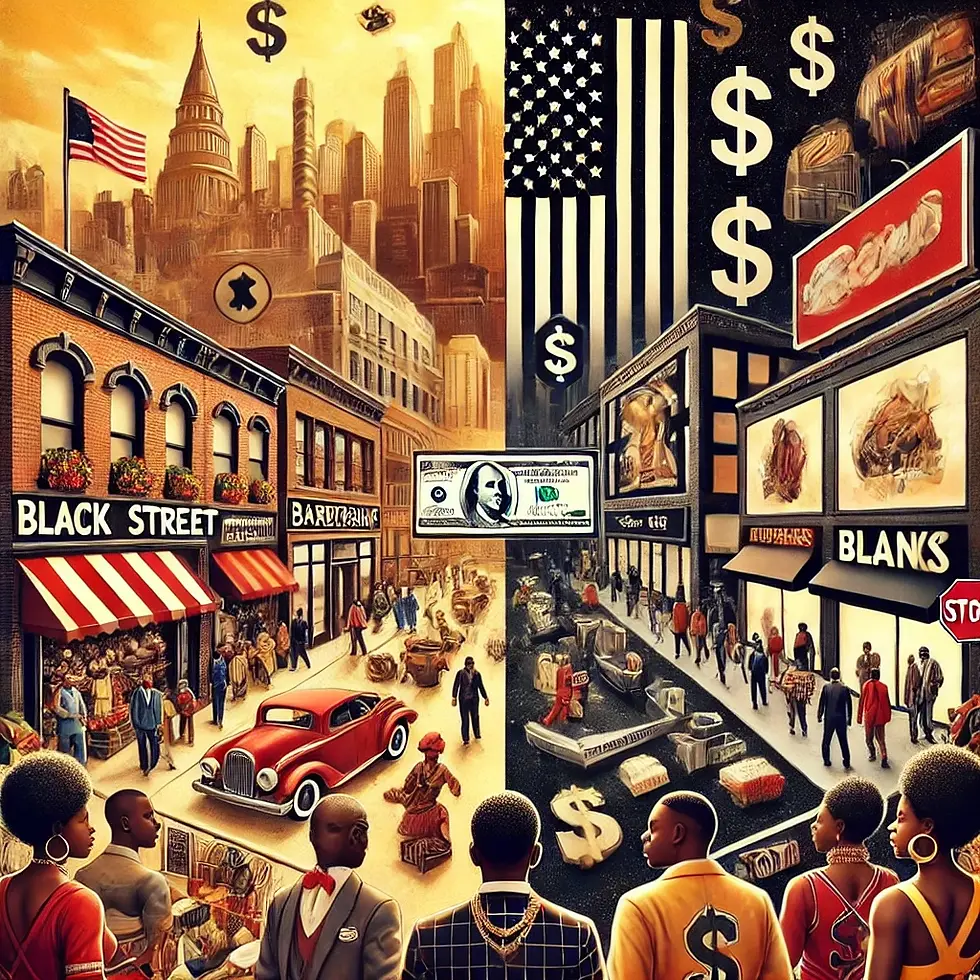
How Stereotypes Impede Progress and Drain the Black Dollar
For centuries, Black people have been subjected to exaggerated, harmful caricatures that distort reality and serve to justify systemic oppression. These misrepresentations—ranging from the servile Mammy and the buffoonish Sambo to the hyper-aggressive brute and the hypersexual Jezebel—have not only poisoned perceptions but also had tangible consequences on Black economic progress. These stereotypes have limited career opportunities, discouraged investment in Black-owned businesses, and shaped consumer habits that siphon wealth from the Black community.
The Evolution of Black Caricatures: From Minstrelsy to Media Manipulation
Stereotypical portrayals of Black people in the U.S. date back to slavery and minstrelsy, where white actors in blackface exaggerated Black features and mannerisms for entertainment. These images laid the foundation for cultural biases that persist today. In the 20th century, Hollywood reinforced these stereotypes with films like Birth of a Nation (1915), which depicted Black men as dangerous and animalistic, fueling racist violence and discriminatory policies.
Even in modern media, stereotypes endure. Reality television often portrays Black women as angry and combative, while mainstream rap music promotes exaggerated tropes of hyper-masculinity and criminality. These limited and harmful depictions shape societal perceptions, influencing how Black professionals are treated in the workplace, how Black youth are disciplined in schools, and how Black businesses are perceived in the market.
The Economic Impact: Stereotypes and the Black Dollar
1. The Consumer Trap: Misdirected Spending Power
The Black community wields significant economic power, with Black buying power in the U.S. estimated at $1.8 trillion in 2023. However, a significant portion of this wealth does not circulate within Black communities due to deep-rooted consumer behavior shaped by media stereotypes.
Marketing campaigns often reinforce Eurocentric beauty standards and materialistic aspirations, leading many Black consumers to spend disproportionately on luxury brands, beauty products, and entertainment—industries that historically exclude or exploit Black talent. Black people make up roughly 13% of the U.S. population but account for a significant share of spending in industries that rarely reinvest in Black communities.
2. Business Barriers: Stereotypes Undermine Black Entrepreneurs
Black-owned businesses face unique challenges in accessing funding and customers. A study by the Federal Reserve found that Black entrepreneurs are twice as likely to be denied business loans compared to their white counterparts, in part due to biased perceptions of risk and capability. Meanwhile, stereotypes about Black-owned businesses—such as assumptions of inferior quality or poor customer service—discourage potential customers, including Black consumers, from investing in their own communities.
Additionally, the perception of Black professionals as "less competent" or "less professional" has led to fewer opportunities for Black-led startups and executives in corporate spaces. This lack of representation means fewer role models, fewer Black-owned media platforms, and a continuation of narratives that devalue Black talent.
3. Wealth Erosion: Criminal Stereotypes and Economic Disenfranchisement
The portrayal of Black men as inherently criminal has fueled mass incarceration, which has had a devastating impact on Black generational wealth. Studies show that incarceration significantly reduces lifetime earnings, with formerly incarcerated Black men earning 52% less than their peers. The loss of income and employment opportunities further weakens the economic stability of Black families and communities.
Moreover, discriminatory housing policies, often rooted in racist stereotypes about Black neighborhoods, have led to lower property values and higher interest rates for Black homeowners. This structural economic suppression keeps wealth from accumulating and passing down through generations.
Reversing the Damage: The Power of Narrative and Black Economic Empowerment
To dismantle harmful caricatures and reclaim economic power, the Black community must challenge media narratives and actively support Black-owned businesses. Strategies include:
Investing in Black-Owned Media: Representation matters. Supporting Black filmmakers, journalists, and content creators ensures that authentic Black stories are told.
Redirecting the Black Dollar: Prioritizing Black-owned businesses keeps money circulating within the community, creating jobs and opportunities for growth.
Educating Consumers: Financial literacy and awareness campaigns can counteract the psychological impact of stereotypes and promote long-term economic empowerment.
Demanding Corporate Accountability: Holding major brands accountable for fair representation and equitable investment in Black communities can help shift market dynamics.
Conclusion: Kill the Caricatures, Build the Future
The economic suppression of Black communities is deeply tied to the stereotypes that have been perpetuated for generations. By rejecting these caricatures and reclaiming control over cultural narratives, the Black community can reshape perceptions, shift spending habits, and secure a stronger economic future. The death of Black caricatures isn’t just a cultural necessity—it’s an economic imperative.
Sources
Federal Reserve Banks. (2021). Small Business Credit Survey: Report on Firms Owned by People of Color. Retrieved from https://www.fedsmallbusiness.org
Nielsen. (2023). Black Consumers: A Powerful Untapped Market. Retrieved from https://www.nielsen.com
Sundiata, I. (2019). Racial Stereotypes and Economic Disparities: The Impact of Media Representations on Black Wealth. Journal of Black Studies, 50(2), 112-129.
Muhammad, K. G. (2010). The Condemnation of Blackness: Race, Crime, and the Making of Modern Urban America. Harvard University Press.
Kendi, I. X. (2019). How to Be an Antiracist. One World Publishing.
Darity, W., & Mullen, A. K. (2020). From Here to Equality: Reparations for Black Americans in the Twenty-First Century. The University of North Carolina Press.
National Association of Real Estate Brokers. (2022). State of Housing in Black America Report. Retrieved from https://www.nareb.com
Walker, J. (2020). The Black Tax: The Cost of Being Black in America. Vasumi Publishing.
Wilson, W. J. (1996). When Work Disappears: The World of the New Urban Poor. Alfred A. Knopf.
Du Bois, W. E. B. (1899). The Philadelphia Negro: A Social Study. University of Pennsylvania Press.
U.S. Census Bureau. (2023). Annual Business Survey: Minority-Owned Firms. Retrieved from https://www.census.gov
Grier, S. A., & Kumanyika, S. (2010). Targeting Interventions for Black Consumers: Marketing and Public Health Strategies to Reduce Disparities. American Journal of Public Health, 100(2), 224-234.
Miller, M. (2017). Segregated by Design: The History of Housing Discrimination in the U.S. Journal of Urban History, 43(5), 856-873.
Oliver, M., & Shapiro, T. M. (2019). Black Wealth/White Wealth: A New Perspective on Racial Inequality. Routledge.
Burrell, T. (2010). Brainwashed: Challenging the Myth of Black Inferiority. SmileyBooks.


Comments